Thursday, February 23, 2017

KaanchaLonka Dhonepata Baked Fish


The weather has been amazingly warm for February in the last few days. Being from a warm country, I am not very fond of snowy winters, but such high temperatures scare me. With the new administration, there is little thought being given to global warming though it stares us in the face and even my 8 year old understands the impact it can have. If the EPA is not allowed to do the job it should, it is ultimately we, the humans who lose out in the long run.


We went snow tubing this past weekend. It was sunny and warm and the snow had turned to slush in parts. No one even needed a gloves or a cap.  The kids had a whole lot of fun but in a couple of decades we might have to do this whole snow world in a controlled environment indoors.

Now to this Green Chili Coriander Fish baked in the oven which is  much loved in our home. Big Sis is happiest when dinner is this particular fish dish and rice. It is also so easy to make that I don't have to do any prep work if the ingredients are at hand.

Surprisingly, this fish was inspired by a Lemon-Coriander Fish not from any Michelin starred restaurant but my Etihaad flight last year. I have not seen anyone else take their in-flight dinner so seriously, that too an in-flight dinner devoured in company of absolute strangers in a tight economy seat. But I had honestly liked the fish they had served with couscous.

It had uplifted my spirits even even when I was missing all the tyangra jhal charchari and golda chingri that I was leaving behind. As much as I like my golda chingri kalia, I know that it is not what I will rustle up for a weeknight dinner. For that, inspiration has to come from elsewhere. In this case, it was at 40,000 ft high!

Soon after I came home,I searched up the recipe and then tweaked it enough to make it kick-ass Bengali. Few green chilies will do that for you!


Saturday, February 18, 2017

Thai Red Curry with Shrimp -- comfort food


Thai food is comfort food for us. Well at least for the two adults and the teen. Little Sis does not like Thai food!

Don't ask me how this is possible but the more I see my kids, the more I want to get their DNA checked. I don't know where they carry these traits from. So anyway for a long time all that Little Sis would eat at our favorite Thai place was their jasmine rice with a little bowl of ketchup+hot sauce on the side. I was okay with it as long as there was no impediment to my pad thai. As she grew older and became an active member in voting "Where do we go out for dinner on Saturdays?", she also became a vociferous opponent of our favorite Thai place. Imagine the horror. Instead of a nice bowl of Tom Yum soup we were being subjected to mac n cheese, how so ever gourmet it may be.

Only recently she has taken an infinitesimal amount of liking for Tom Yum soup which she eats with a side of jasmine rice. As long as she does not vote out our Thai place, I really don't care.

Now, since making a Thai Red curry is something which has a huge ROI, with little work to do and a huge return on flavor, I make a Thai red curry at home often. Little Sis does not eat it but Big Sis slurps it up. It really is a pretty simple dish to make if you have these two ingredients. Thai Red Curry Paste and a Can of coconut milk. I like the Maesri brand of red curry paste and have not tried other kinds.


To make a Chicken Thai Red Curry follow this recipe

Today we will make Shrimp Thai red Curry

Shrimp Thai Red Curry

Start off with 1 lb of fresh or frozen raw shrimp. If you are buying fresh shrimp, buy the ones without the head. Clean the shrimp which means take out the black thread like thingy on the back of the shrimp and rinse in running water. Toss the shrimp in salt and keep aside

Fry 1 small onion, chopped in pieces, cool and make a paste

Heat canola or vegetable oil in a wide pan

Saute the shrimp lightly until they change their raw coloring. Take out and keep aside

To the same oil add 2 cloves of garlic minced. If you have Thai Basil leaves, add about 3-4 of them too.

Once you get a beautiful flavor, add the Onion paste and fry for a minute

Add 1 red bell pepper and 1 green bell pepper chopped in medium sized strips. Saute for 2 minutes

When the Pepper turns soft add 2-3 tbsp of the Red Curry Paste. Saute and cook with sprinkle of water for the next 2-3 minutes

If you have bamboo shoots,add 1/2 a can of bamboo shoots. Saute

Add 1 can of Coconut Milk + 1/2 Cup of water. Mix well and adjust for salt. Let the gravy come to a simmer. I usually let it simmer at low-medium heat for 6-8 minutes as I see it helps the flavors to blend well.

Add 1 tsp sugar and cook to desired consistency. By this time the gravy will have a beautiful color.

Now add the cooked shrimp and let the gravy simmer for 2 more minutes.

At the very end add the Lime Zest or Kafir Lime Leaves. Serve with rice.


If you like what you are reading, get Bong Mom's Cookbook in your mailbox
Enter your email address:


Delivered by FeedBurner

Sunday, February 05, 2017

Kashundi Egg Salad -- Indian style


First to dispel any myths, no one from my family back home will call this a Bengali egg salad. They will call this "dim seddho makha" -- boiled eggs mashed up and leave it at that. This is something that we ate almost routinely for breakfast, along with mashed potatoes, rice and a dollop of ghee.

"You ate all that in the morning before going to school?", my daughters often ask, their voice incredulous, their eyes weary looking at their mother who was ok eating all of rice, potatoes, eggs and ghee in the wee hours of the morning!

I look back with surprise too. How on earth did I manage to scarf down all of that before rushing off to the school bus stop at 8 in the morning! But then I loved eggs. I still do. The husband-man shares a similar love of eggs. If we ever have to share a boiled egg between us, it is a moment of heightened tension, cutting the egg with finite precision, so that no one gets away with a bigger share of the delicious egg yolk. The girls, unfortunately do not share our love for eggs. I would have never ever imagined that my own progeny would refuse to eat an cooked egg yolk, but if I look at the positive side, it only leaves more for me.


I am not a big fan of the egg salad that is very popular in the western world. However I cannot deny that it is an extremely easy dish to make for picnics or even parties when served right. You can serve them as a crostini on a piece of french baguette or on crackers and bam you have a quick and easy appetizer ready!


Saturday, January 28, 2017

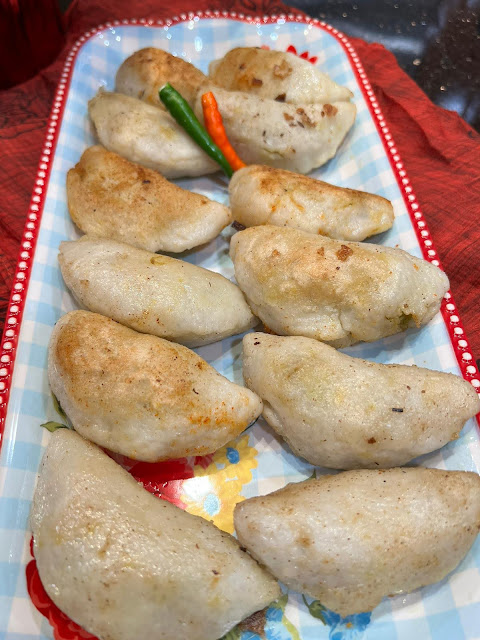
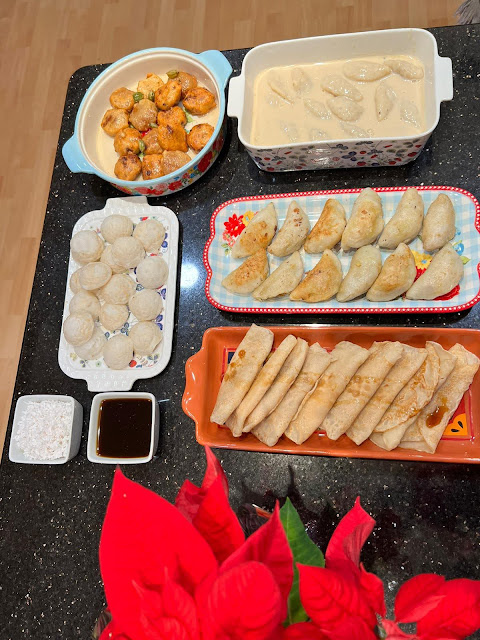
Sanhita's Nonta Bhapa Pithe | steamed rice flour dumplings

Nonta Bhapa Pithe | Steamed Rice Flour Dumplings

Nonta Bhapa Pithe  | Jhaal Pithe | Steamed Savory rice flour Dumplings

Pithe is reminiscent of the times when paddy was harvested in the months of December-January and the new crop was celebrated by making dishes that used rice, date palm jaggery(khejur gur also collected in the winter months) and coconut. There are a variety of pithe and puli made from these ingredients - patishapta, doodh puli, gokul pithe, bhapa pithe, chitoi pithe etc. While most of these have a sweet coconut-jaggery stuffing, the Nonta Bhapa Pithe is a steamed rice flour dumpling which has a nonta aka savory stuffing. It is also called jhaal aka spicy pithe because of the stuffing.

When the world around us is in a tumultuous state, among the few things that bring sanity, is food that has ties with our roots. Those ties might be frayed and not often remembered but it is there, a gentle reminder of who we are and how our journey has been. How in this global world, we have all immigrated, far from our roots, whether it is within the country or outside. There is comfort in knowing recipes that are old and yet have stood the test of time and movement. Knowing that this was the food prepared and consumed by my kin, in a different era, different world, in times of different beliefs, gives us strength in its perpetual persona.

Pithe,is reminiscent of the times when paddy was harvested in the months of December-January and the new crop was celebrated by making dishes that used rice, date palm jaggery(khejur gur also collected in the winter months) and coconut. Poush Parbon or Nabanno was a celebration of the new crop of rice, which was the mainstay for the then agrarian society. We have moved many years forward from those times where rice is now GMO and harvested multiple times and grated coconut can be found in the frozen aisles of grocery stores. Yet, we still take the effort to celebrate poush-parbon, in our home to honor those simpler times when we revered soil and its bounty, instead of taking it for granted like we do now.


Usually during Poush Sankranti, I hover between my fail safe recipes of paati-sapta and gokul pithe. I have never tried to make pithe with rice flour which is quintessential part of poush parbon for Bengalis. My Ma makes puli pithe which are rice flour dumplings shaped like a small rugby ball and stuffed with nice things like kheer or coconut. These "pulis" are then steamed and dunked in a milk based paayesh. I have never been fond of them or tried to make them. There was a nonta pithe or bhaja pithe that my Ma used to make with sweet pea stuffing. Those I loved butI have never worked with rice flour so didn't try making those either.

That doesn't mean, I miss those though. I know an amazing bunch of folks who are all very talented when it comes to cooking. One of our friends Sanhita, is an expert when it comes to whipping up traditional Bengali delicacies. Every year during Sankranti, she takes it upon herself to make all kinds of pithes and pulis, and then invites all of us over to her home for a pithe party. Didn't I say, I had amazing friends?


Monday, January 23, 2017

Spicy Green Beans in the Oven

Today Big Sis was talking about a friend of hers who is apparently very rich by hearsay.

Little Sis listened to the discussion for a minute and then declared "I will never be rich. Being rich is a waste of time!"

Astounded by this bite of information I asked, "Why is it a waste of time?"

Little Sis: "Well to become rich, you have to work hard and that will get you lots of money. Working hard is a total waste of time!"

I was left standing, my mouth agape, while Little Sis confident in her knowledge went off to bed.

But I am totally with her on the "working hard is a waste of time" funda. No wonder I don't like chopping vegetables. Any dish that calls for elaborate chopping of vegetables, is subtly skipped for better days, when I have ample time for an interesting movie to give me company while chopping. There can be nothing more boring than chopping vegetables while doing nothing else.


This Spicy Green Beans in the oven is the perfect recipe that lets me skip chopping, well a large part of chopping. You will have to use the knife but barely. For me, a bag of fresh trimmed beans from Costco does the trick. If you are buying from anywhere else, you will have to trim the ends but that's about it.

Spicy Green Beans in the Oven

Take a bunch of tender green beans. If you can get hold of trimmed beans you are in for immense good luck and fortune. If not, well then, you will have to trim the beans by sniping the head and tail.
Also "Tender" is the keyword here, but isn't that true for all vegetables.

Give them a rinse and pat dry.

Chop half an onion and two cloves of garlic in thick slices

Put beans, onion and garlic in a wide mouthed bowl

Toss them all together with
1 tsp garlic powder
1 tsp red Chili powder/Paprika
1/2 tsp of Cajun Spice powder(or any other spice. Aamchur and Bhaja Moshla can do the trick too)
salt to taste
2 tbsp Olive Oil

Let them sit in the marinade for 15-20 mins.


Now put them in a single layer in a baking tray and bake at 400F. Halfway through(after 15 mins) drizzle a tsp of olive oil and give them a stir.

Bake until the beans are brown and crinkled. We like them crispy so we bake for 30 mins.

While serving add a new dimension by adding either
slivered almonds
or feta cheese
or chaat masala and lime juice


If you like what you are reading, get Bong Mom's Cookbook in your mailbox
Enter your email address:


Delivered by FeedBurner

Saturday, January 14, 2017

Pyarakia or Gujiya -- sweet and savory


I had no intentions of making anything for Sankranti. As I always say, I don't want to eat any more sweet in January and the only things  I can make for Poush Parbon are sweet -- Paati Sapta and Gokul Pithe. I am not confident to make the puli pithe, seddho pithe or any other kind of pithe. Then last night I was talking to my Mom and I was ho-humming over whether I should make Koraishutir Kochuri today. The girls love Koraishutir kochuri and making the pea stuffing is not a difficult task with frozen shelled peas. Then my Mom suggested that I make Pyarakia.

Pyarakia is basically half-moon shaped dumplings made with flour and stuffed with a coconut-khoya filling or a kheer filling. The dumplings are deep fried and dunked in sugar syrup. I loved the ones with a kheer stuffing as a kid. My mother would make them pretty often and I would refer to them as the "binuni wala mishti"-- the sweet with the braided edge.I don't know if everyone calls it Pyarakia as I have often seen this thing going also by the name of gujiya.

Combining kochuri and the pyarakia, I decided to make savory Pyarakias with sweet pea filling. I also made some with a coconut-khoya stuffing but unlike my Mom, I did not dunk them in sugar syrup.

The girls loved the ones with the pea filling better and so did I.

Make the coconut-khoya filling


Take 1 cup of grated coconut. Fresh is better but I used frozen. Microwave the frozen one, to make it soft and fluffy

In the Kadai or Frying Pan mix the grated coconut with 1 cup sugar and mix with hand, pressing a little, so that the coconut will become slightly moist because of the sugar. This step is before the pan is put on the stove.

Next Microwave 1/2 Cup khoya to make it a little soft

Put the Kadhai/Frying pan with coconut mix in it on the stove and stir at medium heat.
Add 1/2 tsp of ground cardamom

Add the khoya and keep on stirring till the mixture turns a light brown and is sticky. At this point the mix should not dis-integrate but should look like a light brown slightly sticky granular substance. It took me almost 30 mins to do this


Make the sweet pea filling

Defrost 1 cup of frozen sweet peas. I usually prefer the Microwave for such purpose.

Put in a blender
the peas
1 tbsp of peeled and chopped ginger
1 green chili(optional)
very little water, a tsp to start with
Make a fine paste

Heat Vegetable Oil in a frying Pan

Add 1/4 tsp of Cumin seeds + a pinch of Hing/Asafoetida. I will insist on this as it lends an awesome fragrance. 

Add the pea paste that you just made. Sprinkle 1/4 tsp of Dry Roasted Cumin + Red Chilli Powder(Bhaja Moshla). Add salt to taste. If your peas are not sweet enough add a little sugar. If you like it hot add some Red Chili Powder. Improvise.

Now keep stirring till the water from the pea mix totally evaporates and the mixture becomes dry, thicker and congeals. This takes a good 20-25 minutes or more. Basically it should come to a stage where you can make a small ball for the stuffing.

Make the Dough

In a bowl take 1 Cup of Maida/AP Flour. Add a pinch of salt.

To it add 2 tbsp of vegetable oil or ghee. Mix with the tip of your fingers to get a crumbly texture.

Add warm water gradually to make a stiff dough. The dough will not be as soft as the one you make for luchi/poori/kochuri.

Wrap the dough with a cling wrap or damp cloth and keep aside for 15-20 minutes


These are the two stuffing I made -- sweet coconut-khoya and savory sweet pea


Take a small gooseberry sized ball of the dough and roll it out in a circle. Take a small ball of the stuffing and put it in the centre of the circle.

This one has the sweet coconut filling


This one has the savory sweet pea filling


Fold the circle to make a half-moon shape. Press and seal the edges with the tip of your finger. Make sure the edges are sealed properly, else the stuffing will come out while frying.


You are ideally supposed the braid/pleat the edges as you can see in the photo below. I was not good at that and so with the back of a fork made the empanada style markings to seal the edges


The husband-man could braid the edges. Yeahhh!!!!


Heat enough oil in a deep bottomed kadhai  for deep frying. Ignore the black edges. This is our deep-frying kadhai and this is how it is supposed to look.

When the oil is hot, gently put a dumpling in the oil. Fry each side for about 30 secs by which time it will be a nice brown. Flip and fry the other side.. Take it out with a slotted spoon and put on a plate lined with kitchen towel to drain the excess oil


The girls loved the ones with the spicy pea filling


If you like what you are reading, get Bong Mom's Cookbook in your mailbox
Enter your email address:


Delivered by FeedBurner

Wednesday, January 11, 2017

Oats Upma -- when you are trying to eat healthy


After eating the totally delicious pound cake for a month, I realized I needed to stop! I mean really, really stop and do something. Of course as a fallout of all the cake eating, there was a question of the weighing scale in my bathroom groaning and complaining. I couldn't let a weighing scale ruin my life could I ? So I actually moved it in the closet and shut the door on it.

But then Big Sis declared a restriction on my eating pound cakes, saying I should only eat one slice a week. It was a difficult rule to stick to, which meant I didn't stick to it, and all slices of pound cakes in my pantry were finally finished. This is when I realized I should really stop and go back to my healthy lunches routine.

I am good with my healthy lunches usually but I have realized if I fall through the crack, the crack morphs into an abyss and I have a harder time getting back up. It had to be something simple and yet tasty to haul me back on track. So I was back at making my Oat Upma. I like my oatmeal with mangoes and yogurt but this spicy oat upma is different. It doesn't make you feel all martyr like and holy and sacrificial because you are eating oatmeal while the world besides you is chomping on a philly cheesesteak. You feel proud about it actually and it only takes minutes to make.

Now in our home, we make this with steel cut oats as that is the only kind of oatmeal we buy(unless we are making oatmeal cookies which needs rolled oats but I will not talk of cookies any more). Also the husband-man usually make the oat pulao  but my method is little different from his !!! This time I bought a quick cooking steel cut oats which cut down the time to make this dish by 1/3rd, so if you find this particular kind in your store, do get it. And no, Bob's Red Mill did not sponsor me or even cares how I make my oats.


Saturday, January 07, 2017

Happy New Year with Deepshikha's Pound Cake


There are pound cakes and then there are pound cakes. Well, if I am absolutely honest, all pound cakes are amazing. I love their no-nonsense fluffy taste. But I am not sure if they are all as easy to make as Deepshikha's Pound cake.

It all started when our friend Deepshikha brought over individual cake loafs for us back in November. She has this charming habit of carrying home made goodies every time she visits. And when I say visits, I mean the long 10 hour drives from Ohio. I still remember her oatmeal raisin cookies way back in 2004, when I had no clue that such stuff could be made at home.

This time it was pound cakes. These quaint little loaves of pound cakes were so good that I had to stave off our other friends from finishing them. Actually, I will tell you a little secret. I hid one of the loaves that she gave me and did not take it out even when the other friends we had visiting were asking for more!Yes,I am evil like that.

And guess what the best part was ? These cakes needed only oil, no butter. If you know my baking disasters, you would know my woes about creaming butter and sugar. So any baking recipe that does not warrant that step is very very close to my heart. Also,Deepshikha had baked hers with Olive Oil and it tasted as good.

Here is the recipe she shared with me. I used regular Vegetable Oil. Also I used zest of half an Orange as I love citrus flavor in my cakes. They were so so good. The beauty of the recipe is that it doubles and triples very nicely. So to make 3 loaves of these cakes, just multiple every ingredient amount by 3.
Next time, I will make 6 of these and hide them from the family too.


Easy Pound Cake with Oil and Orange flavor

What You Need

AP Flour -- 1 Cup
Sugar -- 1 Cup

Oil -- 1/2 Cup
Eggs (at room temperature) -- 3

Baking Powder -- 1/2 tsp
Salt -- 1/2 tsp
Vanilla 1/2 tsp

Orange zest -- 1 tsp (optional)

How I Did It

Prep the wet mixture

In a bowl, beat the eggs. For about 3 minutes.

Next add the sugar to the eggs and beat again for 4-5 minutes at medium speed.

Now goes in the oil. Beat again at medium for 3 minutes.

Add the vanilla extract

Dry Mixture

In a separate bowl sift the flour, salt and baking powder. Add the orange zest to the flour and lightly rub it in with your fingers.

Combine

Slowly add the dry mixture to the wet mixture, mixing briefly at a very low speed, until everything is combined.

Bake

Pre-heat oven to 350F.

Grease a 9"x5" loaf pan generously with oil and pour the cake batter in it

Bake at 350F for 45 minutes to an hour. Do the toothpick test. Take a clean toothpick. Insert it in the center of the cake. If the toothpick comes out clean, the cake is done. If it has batter stuck to it, you need to give few more minutes.
Note: If you see the top of the cake is browning fast but the inside is not cooked, loosely cover the surface of the cake with an aluminum foil and continue baking. Towards the end of the bake time, remove the cover and finish the baking.

When cake is done, take out from the oven and let it cool. Be patient.

Eat.


If you like what you are reading, get Bong Mom's Cookbook in your mailbox
Enter your email address:


Delivered by FeedBurner

Friday, December 30, 2016

Shrimp in a garlic-chili- basil pesto -- quick appetizers

I have been away from my blog for a while. There were more important thing at home that needed attention and so though I was cooking our daily meals, I was not in the mood to take pictures and post them! You know how it is right ? I bet each of you have been through the highs and lows of the ride that is called life. I can only be very very thankful that we have been through it with everything ending on a positive note. **fingers crossed**


Now let's get back to business and discuss finger foods or appetizers for the New Year's eve party. Whether you are having a "dhamaka" party or a quiet family time ushering in the New Year , we all do understand that the most important part is the "food". The New Year will bring many things with itself, the foremost being loads of resolution on diet and exercise. In face of that, lots of lip-smacking appetizers at the year end party, seems like a good start.


1. Shrimp in a Garlic-Chili-Basil Pesto


To make this easy-peasy you start off with store bought Basil pesto and off course store bought Shrimp.

If shrimp is frozen, defrost it by putting it in cold water. Never ever microwave it or defrost in hot water.

Shrimp -- 12 medium sized shrimp

Next, in a blender add
2 heaped tbsp of basil pesto
2 cloves of garlic chopped
2 green chili
1 tbsp Olive oil
Make a smooth paste

In a bowl marinate the defrosted shrimp with
salt,
garlic-chilli-pesto you just made
keep aside for 10-15 minutes

Pre-heat oven to 350F

Line a baking tray with aluminum foil. Put the shrimp in it in a single layer. Drizzle some more Oilive oil

Bake in oven for 7 mins. Then turn the tray around and bake for 7-8 more minutes. The shrimp will be cooked by total 15 minutes.

Take it out. Serve with a squeeze of lime juice


2. Puff Tartlets with different filling

This is a very popular snack with the kids. You can do a potato filling, a fish filling or a keema filling. You can prep the stuffing a few days ahead and then you have less work to day on the day of the party


3. Chicken Meatballs

This is another quick and easy favorite


In a bowl add 
1 lb of ground chicken

To it add
1/2 of a red onion finely chopped

1 clove of garlic minced
1 geen chilli minced
1/2 tsp garlic powder
1 tsp Tandoori Masala(Raja Brand is good)
1/4th cup Bread Crumbs

Finely chopped mint and coriander leaves. Dried mint also works very well.
Salt and pepper

few drops of olive oil
Work everything well into the mix and keep aside for 30 minutes

Fashion balls or patties of this mix. Freeze them in single layer. NoteUsually I will make one ball, fry and do a taste test. I will then adjust the seasonings in the mix and proceed to make the other meatballs.

You can either fry them or bake them to serve. While frying very little oil is needed if you have shaped them in small flat rounds.


If you are baking, bake at 350F on a greased tray for 20 minutes or until the meat is cooked. Then take the balls out and shallow fry in a frying pan to brown the outside

For shallow frying, make small round and flat patties. Shallow fry them in hot oil


Serve them on a bed of fresh salad or with a yogurt dip

Another recipe for similar meatballs is here

4. Stuffed mushroom with mascarpone

This stuffed mushroom is my absolute favorite. Read the recipe, there is a version with mascarpone cheese, I absolutely love. If you like mushrooms, you are going to love that one.


If you like what you are reading, get Bong Mom's Cookbook in your mailbox
Enter your email address:


Delivered by FeedBurner

Monday, October 24, 2016

Narayan Pujo'r Shinni - a Prashad fit for Dessert


Bengali Shinni - a Prashad fit for Dessert

Shinni, is a very simple prashad made with atta(whole wheat flour), sugar, bananas, milk--- many of you are thinking banana bread at this point but no--all mixed together with hand and offered to Lord Satya Narayan. This is a typical prashad made only during Satya Narayan Pujo in Bengali households. There is a very interesting story associated with this puja and subsequently the proshad. Centuries ago in Bengal, the Satya Narayan Puja was performed by Hindu women, but they prayed interchangeably to Satya Pir(a Muslim fakir or saint) or Satya Narayan (an avatar of Vishnu). As per the story, Satya Pir or Satya Narayan, the lord himself, had asked his devotees to prepare this simple prasad and even given them a rough recipe with ingredients available to all. Since then this simple proshad is what is made to appease him during Narayan pujo


I am not a very ritualistic person. I am kind of wishy-washy around them. If a ritual is something that my heart takes after and is easier to get done with, I will do it. If not, I will probably skip. I am not a very religious person either or rather I am not very ritualistic about the religion that I follow. I like praying and I light incense sticks almost every other evening for a set of gods in my Puja corner. It doesn't matter if I am having my periods, I will still do it. If I don't feel like on some evening, I don't.


This is very different from the way I have grown up in a home where rituals were strictly adhered to.

With age, I see my parent's vision has changed regarding religious rituals too. My father is no longer as conservative as he was some twenty years back. He reads vedas and the other day was telling me, how some of the words in Sanskrit mantras like "Hrring", "Krring"-- which are actually sounds(dhwanis) with no literal meaning -- were actually derived from the sounds of nature, which was what the early humans were afraid of and thus prayed to. His belief in the ritualistic form of prayers has waned too, making it easier for me to relate to his pujas.


So this time when my parents wanted to do the Kojagari Lakhsmi Pujo , which they have been doing at their own home for many many years on the night of the first full moon after Durga Pujo, I agreed to all the little nuances. I do this Pujo, other years too, but in my own very random way. This time I agreed to the rituals as they did not seem too rigid and gave me excuses to buy the the brass lamps I have always had eyes on.

Since we were having the Pujo, I asked my Mother to make Shinni. Shinni, is a very simple prashad made with atta(whole wheat flour), sugar, bananas, milk--- many of you are thinking banana bread at this point but no--all mixed together with hand and offered to Lord Satya Narayan. This is a typical prashad made only during SatyaNarayan Pujo but I love it so much that I insisted and my Mother obliged this time.


Monday, October 03, 2016

Sondesh -- the fabled Bengali Sandesh

Sondesh, Bengali Sondesh, Sandesh

Sondesh | Bengali Sandesh

Sandesh is a popular Bengali sweet made from fresh chhana/chenna aka home made paneer also known as curdled milk solids. The chhana is kneaded with sugar and different flavorings to make different variety of Sondesh. Different kind of kneading from smooth to grained, leads to different types of sandesh.


A Bengali Food Blog and not a single Sondesh recipe in there. "Chee, chee, ...", the Bengali Mashima in her wide red bordered spun cotton sari spat out a stream of betel juice in disgust. The other ladies in their filigreed gold bangles stopped midway in their task of "boron", feeding Ma Durga pieces of sondesh and smearing her with Sindoor on BijoyaDashami, and looked at me with rebuke writ on their face. Ma Durga's face shimmied in the rectangular mirror placed for Dorpon Bishorjon. I hate betel juice and was about to say a few choice words to Mashima when the darn alarm went off.

Phewww...so this was just a dream, I looked around trying to spot betel juice stains lurking in any corner. None. That settled, I switched my thought to Sondesh or rather Shondesh. Really , why did I not have a decent sondesh recipe on my blog ? I did have two "faankibaaji" recipes but not the real deal. Why oh Why ?

"Wait. I can explain", I said. And then I gulped for what I was going to say was close to blasphemy. But "Honesty is the Best Policy" was my favorite topic to write essays on and so I decided what the heck...I do not like Sondesh. That is the sweet Sondesh. I have always liked the children's magazine Sondesh but that we are not discussing here. There, I said it. Sondesh does not feature among the sweets I would like to eat after I have come back from Mars or the Alcatraz. Nope. I will take Kalakand, KheerKodombo, Crisp raas soaked Jilipi, ChamCham, Kheerer Shingara, Motichur Laddus, Chanar Jilipi, Ledikeni, Kheerer Naaru, LobongoLotika and then, only then shall I consider the Sondesh.


I have no concrete reasons why I don't like it given that all my childhood, my Ma kind of force fed me Sondesh. Every winter vacation that we spent in Kolkata was marred by huge Kara Pak er sondesh from Balram, Taal Shaansh sondesh or Jol-Bhora sondesh made of nolen gur with a spot of liquid jaggery in the core from Sen Mahashoy, creamy white shaankh sondesh shaped like a conch from the Kalika Mishtanno Bhandar near my Dida's home and several variations of the same stuff again and again.

In absence of these in our Bihari town Ma made them at home, making fresh chhana and shaping the sondesh with her dark black stone molds.I hated them all. Well "hate" is a strong word but I didn't really take to Sondesh like a Bong should. I did prefer the "Makha Sondesh", moist, warm and fresh over the harder and dried Kara Pak er sondesh but nothing to go ga ga about. The only variation of sondesh that I like is one where my Ma adds kheer to the channa and thus makes a Kheer-Chhanar Sondesh.

Many, many years later I made norom paak er sondesh at home on this Bijoya Dashami. As if the house move was not exciting enough and I needed more. I had a stash of Khejur Gur from last year and I wanted to use it to make Nolen Gur er Sondesh . I used both sugar and the jaggery but if you have enough of the Khejur Gur I suggest you use more of it. So anyway the sondesh was easy to make and pretty decent to eat, so it is definitely worth a try. If I could have done it, so can you. And then if you fall in love with the famous sweet all the more better for you.


Sondesh -- is a popular Bengali sweet made from fresh chhana/chenna aka home made paneer also known as curdled milk solids. The chhana is kneaded with sugar and different flavorings to make different variety of Sondesh. Different kind of kneading from smooth to grained, leads to different types of sandesh. Traditionally only delicate flavorings were used for sandesh like rose or saffron and notun gur in winter. While the raw flavored and sweetend channa/chenna is made into KaanchaGolla, the kneaded chenna is put back on heat and cooked further for different durations to make different kinds of sondesh. The first Sandesh was introduced by Bhim Nag in 1826 but Nakur Chandra, Sen Mahashoy and Balram are some of the oldest and famous sondesh makers of the city

Nolen Gur er Sondesh -- This is a sub-species of Sondesh found only in the winter season. The sweetener for this Sondesh is Date Palm Jaggery or Khejur Gur. This enchanting and aromatic jaggery is made by collecting the fresh sap of Date Palm Trees on foggy winter mornings. The Notun gur er sondesh has a coloring that varies from pale to a deeper shade of brown and a heady aroma if the Khejur gur is good quality.

Kaanchagolla -- In this variety the fresh warm chhana is kneaded with sugar or jaggery and then tossed into balls.The chhana is not cooked for this. Natore, a town in Bagladesh is famous for its Kaancha Golla.

Norom Paak Sondesh - In this variety the chhana/chenna after kneading with the sugar or jaggery is then put back on heat and stirred gently at low heat for a few minutes to form a soft grainy mix. "Paak" means to cook while "Norom" means soft, and that explains the process. This soft grainy mix is either shaped with molds or tossed into soft round balls. The soft grainy mix which has not been shaped yet is called "makha sondesh". The molded ones usually have the shape of conch or fish, the traditional symbols in a Bengali home.Guptiparais the home of Bengal’s first community Durga puja, the place where first branded Bengali sweets graduated from makha sandesh (sandesh mixture) to gupo sandesh (a variety of sandesh pieces)

Kora Paak Sondesh -- This is a harder variety of sondesh where the chhana/chenna is stirred for a longer time to make it hard. I have no idea how they then mold or make shapes out of it.

A very interesting article on Sondesh of Kolkata is here.


Sondesh

What You Need

Whole Milk -- 4 cups (~ 1 liter)
Lime Juice -- 2tbsp (almost 1 whole lime)
Sugar -- 1/8th cup (= 2 tbsp)
Khejur Gur -- 1/8th cup (= 2tbsp)

Note: Adjust the sugar and jaggery to your taste.You can use no sugar and all jaggery too.


How I Did It

Step 1-- Curdle Milk

Bring 4 cups of whole Milk to boil.
When the milk is boiling add about 2tbsp of Lime juice. Lower the heat. Almost in seconds you will see the milk curdle and clumps of white milk solids forming.When you see the greenish water separating take it off from heat. Let it sit for 30 secs or so.

Step 2 -- Drain chhana

Now line a colander with cheesecloth and drain the chhana/chenna/paneer. The greenish hued whey is great for making roti dough says my Ma. Next lightly rinse the chhana with water to remove the lemony taste and let it drain.
After few minutes gather the ends of the cheesecloth to form a purse like shape and squeeze out the remaining water from the chhana. Next put it on a flat plate and weigh it with a slightly heavier object and let it remain like that for the next hour.I used my mortar for weighing down, I remember my mother using her nora.

Step 3 -- Knead Chhana with sugar and jaggery

Now we have to knead the chhana. Knead the chhana with the heel of your palm for about 4-5 minutes. Add about 1/8th cup of fine sugar and knead for 4-5 more minutes until the sugar is totally mixed with the chhana. 


Since the khejur gur is usually hard, we will microwave 1/8th cup of jaggery + 1 tsp of water for few seconds to soften and then add it to the chhana. If your khejur gur is already soft, you don't need to do this. Knead for 5 more minutes until your palm is oily with the fat from the chhana.

At the end of this kneading, the chhana will look like a smooth ball of dough. Take small portion of it and toss to make small balls. These sweetened balls of raw chhana are called KaanchaGolla.

Step 4 -- Paak or Cook Chhana

Now we will do the "paak" or cook. Since I am doing a Norom Paak er sondesh we will be cooking the chhana at a very low heat.

To add saffron to sondesh, warm 2 tbsp milk in microwave and soak saffron strands in it.

Put a non-stick pan on low heat and add the kneaded, sweetened chhana. Add the saffron and milk. Stir and cook at low heat. Keep stirring with a spatula for next 10-15 minutes or so. The chhana should come together and will no longer stick to the pan by the end of this time. Take a small portion of the chhana and try rolling a ball. If you can make a smooth firm ball, the chhana is ready!

Step 5 -- Shape cooked chhana to make Sondesh

Now take out the warm chhana and immediately shape with molds or just toss into balls. If you wait, it will harden and you cannot shape it. For further decoration you can warm few strands of saffron in drops of milk and dot each sondesh with the saffron or add bits of pista.

Updated on October 2nd, 2016: Khoya and Chhana Sondesh


On this Mahalaya, we made sondesh again. My Mother presided the process, the girls helped in kneading the chhana and shaping the sondesh and I did the rest. Three generations of women made sondesh on Mahalaya to welcome the Goddess. It seemed to hold a special meaning for us. This time, as advised by my friend J, I mixed khoya and chhana to make the sondesh. I liked this one better than the ones made of pure chhana but if you like the pure chhana sondesh stick with the previous recipe.


What You Need

Whole Milk -- 2 liters
Lime Juice -- 2tbsp (almost 1 whole lime)
Vinegar -- 1 tbsp

Khoya -- 6 oz or 150gm of store bought khoya(In the US, we buy a 12 oz block of Nanak khoya, half of which was used)

Sugar -- 1/2 cup
Khejur Gur(Bengal Date Palm Jaggery) -- 1/2 cup
Note: Adjust the sugar and jaggery to your taste.You can use no sugar and all jaggery too.


Makes about 24 sondesh

Step 1-- Curdle Milk

Bring 2 litres of whole Milk to boil.
When the milk is boiling add about 2tbsp of Lime juice + 1 tbsp of Vinegar. Lower the heat. Almost in seconds you will see the milk curdle and clumps of white milk solids forming.When you see the greenish water separating take it off from heat. Let it sit for 30 secs or so.

Step 2 -- Drain chhana

Now line a colander with cheesecloth and drain the chhana/chenna/paneer. The greenish hued whey is great for making roti dough says my Ma. Next lightly rinse the chhana with water to remove the lemony taste and let it drain.
After few minutes gather the ends of the cheesecloth to form a purse like shape and squeeze out the remaining water from the chhana. Next put it on a flat plate and weigh it with a slightly heavier object and let it remain like that for the next hour.I used my mortar for weighing down, I remember my mother using her nora.

Step 3 -- Knead Chhana with sugar

Now we have to knead the chhana. Knead the chhana with the heel of your palm for about 5-10 minutes. Your palm should be oily at the end of kneading and the chhana should have come together.
Add about 1/2 cup of fine sugar and knead for 4-5 more minutes until the sugar is totally mixed with the chhana.
At the end of this the chhana will look like a smooth ball of dough.

Step 4 -- Getting Khoya ready

Soften the Khoya in Microwave. Crumble up the khoya and put in your mixer with a tbsp of milk and blitz it to get smooth khoya


Step 5 -- Paak or Cook Chhana

Now we will do the "paak" or cook. Since I am doing a Norom Paak er sondesh we will be not be cooking the chhana to hardness. We will also add the khejur gur at this point.

The khejur gur is usually solid, so in a microwave safe bowl, add 1/2 cup of loosely packed Khejur Gur and 1 tbsp of water. Microwave for a minute or until the jaggery melts.

For the "paak", put a non-stick pan on low heat and add the khoya and the liquid jaggery. Stir around for couple of minutes. Then add kneaded, sweetened chhana. Mix with your fingers. Keep the heat at low so that you can mix with hand.

After you see that the khoya and chhana have mixed together, raise the heat to medium and stir continuously for the next 15 minutes. The chhana mix will slowly come together and will no longer stick to the pan. When you can take a little of it and make a ball, you know it is done.


Step 6 -- Shape cooked chhana to make Sondesh

Now take out the warm chhana and immediately shape with molds or just toss into balls. If you wait, it will harden and you cannot shape it. If you have the sondesh moulds, grease them with ghee. Put a ball of sondesh on the mold and press to flatten it out so that it hugs the shape of the mold. Gently pry it out and put on a plate.
Keep a bowl of water handy to dip your fingers and proceed with the next ball.
For further decoration you can warm few strands of saffron in drops of milk and dot each sondesh with the saffron or add bits of pista.


Tuesday, September 27, 2016

Chicken Rezala -- a regal stew

Chicken Rezala recipe

Kolkata Style chicken Rezala | Chicken Rezala

The typical Bengali style rezala is a mildly spiced, fragrant, yogurt-based stew with chunks of meat. It owes its origin to Mughlai cuisine. This is my recipe of Chicken rezala, which is not exactly like the muslim restaurants in Kolkata but close.


Mutton Rezala recipe

September is close to an end. Pujo is upon us. And no has any time to breathe. I cannot believe that 8th grade and 3rd grade started in our home 3 weeks back. We are already done with "back to school" nights and summer seems to be a bygone affair.

This summer was special as my parents were here after almost 3 years. They are getting older and the visits less frequent. It is no longer easy for them to hop on a trans-atlantic flight and traverse continents. Both my girls goaded them into coming and once the flight part was put away, they were looking forward to their stay as much as us.
.
We were lucky to do a lot of short trips around the home with them this summer. My father loves visiting places of interest and is comfortable with long walks, while my Mother has a bad knee which prevents her from walking more than a few yards at a stretch or standing for too long.


Thanks to my father, we re-discovered Philadelphia, surprisingly a city which we never thought of visiting unless it involved work or shows or passport office or such. But my Baba, wanted to visit Philadelphia this time and see the Liberty bell. So off we went on a Sunday morning. It was a gorgeous sunny day, one of those summer days when it is not too humid, and Philly treated us so well.

For me, the best part of Philly was the Reading Market. The covered market teeming with various food specialty shops, bakeries and people reminded us so much of New Market. I spent quiet sometime there, roaming around, not able to decide what to eat and then settled for guess what ? The Philly Cheese steak.


Another weekend we went to a beautiful sculpture garden, not too far from home. Again a place that we had always intended to visit but could never make it. The parents definitely enjoyed the sculpture garden with its unique pieces but the kids too had much fun.

Next up was the Dingman's water fall in the Delaware water gap area. Delaware water gap is beautiful with many natural jewels strewn across the area and Dingman's falls with its well constructed pathway was the ideal trail for my Ma. On our way back from the falls, we stopped by the Delaware river. The sky was overcast and soon a heavy shower rolled in. While everyone else ran back to the car, me, my Baba and Little Sis stood under the tree, breathing in the rain and gazing at the sheer curtain of rain falling on the Delaware river. It was a curious thing, how one person from each generation in our family stayed back in the rain and the other went back to the car like sensible beings.

This picture still takes me back to the day and I can hear the rain drumming on the river.


Next up was trip to the Great Wolf Lodge, a indoor water park, which had taken mythical proportions in our home by the dint of sheer marketing. I am glad we finally went and got it over with this summer.

In between we had guests, visits to the beach which is close by, movies and lots of cooking. Well honestly, my Ma was doing most of the cooking. One of the days, I made a Chicken Rezala for them. I usually make the Mutton Rezala as the goat meat packs in a lot of flavor to this otherwise light stew.


Rezala, is a very popular dish in Calcutta, a signature dish speaking volumes of Awadhi influence on Bengal's culinary history. It is a mildly spiced, yogurt-based stew with chunks of meat. To just call it a stew would be undermining this royal dish. It is not just any stew but a stew that is made regal by lightness of its gravy and the fragrance, which comes with use of Kewra and saffron. The best Rezala can be found in restaurants like Sabir's and Shiraz's in Kolkata. To have a plate of their rezala, the pale golden gravy with a thin layer of ghee floating on top and morsels of soft meat, and mopping it up with soft as mulmul roomali rotis is an experience that you would not want to miss.

I would like the add here Prtihs Sen's comments on Rezala here. She has a deeper knowledge on the subject than me and thinks the Rezala has its origin in the Afghani dish names Rasala.

"I would like to tell you my impressions about the Rezala. All muslim cuisine in Calcutta/Bengal is not Awadhi. It harks back many centuries -- from the 12th century onwards -- with the arrival of the Turks and Afghans in Bengal that established Muslim rule. and later ofcourse the Mughals. The Rezala I feel, the word probably originating from Rassala, is of Afghan origin, to be found only in two places in India actually -- Bengal and in the Rampur cuisine of central India, both very different recipes yet both Afghan strongholds at one time. Awadhi cuisine in Calcutta adapted it to fit into their offerings and while it is also found in Lucknow, its not a very popular dish there as it is in bengal. Awadhi rezalas add coconut milk or dessicated coconut." -- Pritha Sen

Tuesday, September 20, 2016

Shosha'r Shukto -- Bengali Shukto with Cucumbers

This post was written way back sometime in July. That is when this dish was cooked and the recipe duly noted. Now when I look back on those long stretch of summer day, I want to throw a tantrum to get them back. But that is not happening. Never does.

So, while I try to brave my soul for fall, you guys take a trip back to summer...


Summer is always busy around home. The schools are over, the days are long and once I am back home, it is impossible to cook when there is so much to do outside. With my Mother here, it has been a slew of lazy days for me, as she is the one cooking up what the granddaughters fancy.

Meanwhile I am staying up late following the conventions and scouring articles about the preposterous things that one of the presidential candidates keeps on uttering. It beats stuff that even Zee TV saau ma's would mutter. If only he would have on 3 pound jhumkas and dazzling bindis, I would know for sure that it was a Ekta kapoor serial and not reality tv.


So anyway in between all this, my summer plants yielded fruits...I mean vegetables. This year we planted tomatoes, peppers , cucumber. Cucumbers mainly because LittleSis picked up a packet of cucumber seeds and wanted a cucumber plant. My dad did the brunt of the work on them but we were not able to build a trellis aka "maacha" for the cukes.. That didn't dither them though and the cuke yield was in plenty. By the time I realized there were so many of them hidden in the vines, they had already ripened and were not the best in a salad.


Ma made a shoshar shukto (cucumber shukto) with them as they were too ripe to eat raw. Why would anyone buy cucumber and make a shukto I wondered ? I mean cucumbers are good enough raw so why cook them ? Also the original Bengali Shukto has done enough to garner a following so why a contender ?

"Well, we had very limited choice of summer vegetables in our times and shukto made with the slightly ripened cucumbers was a welcome change from the daily grind of lau and potol," she said.

Valid point. The shoshar shukto tasted good too. It was creamy and slightly sweet with a faint bitterness of the uchhe. The crunchy boris added the necessary bite to a otherwise creamy dish. Maybe I won't make it often, but if you ever have a load of cucumbers to finish, this is a great way to go.